
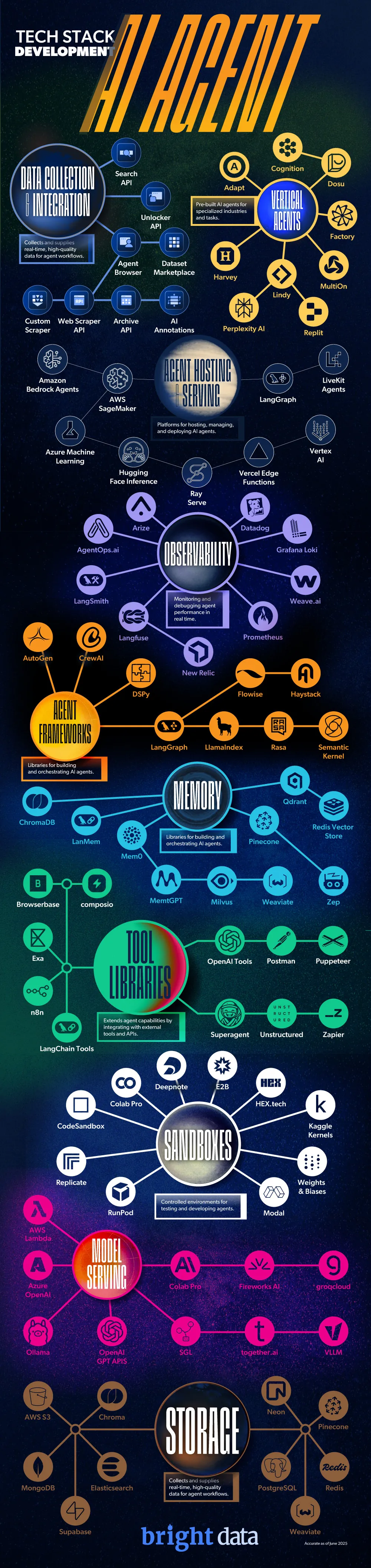
There are many factors to consider when designing an AI agent. Luckily, the tech stack provides a framework in which developers can effectively build agents. Made up of a system of layered tools, the tech stack is what enables agents to reason, act, and evolve.
Data powers agents, making it the recommended starting focus for developers. When it comes to the tech stack, data collection and integration is the layer in which developers connect the agent to data sources. Perusing real-time data allows the agent to understand the world in which it operates, which allows it to make informed and accurate decisions.
Another important layer of the tech stack is observability. The tools in this layer help developers monitor agent performance and debug the agent in real time. Several services exist in relation to observability. For example, developers use LangSmith, Weights & Biases, and WhyLabs when considering observability.
There are many other layers in the tech stack, each with its own specific focus. Examples of other layers include vertical agents, agent hosting services, tool libraries, sandboxes, and storage. Dozens of platforms specialize in various layers of the tech stack, making them valuable tools for developers.
The tech stack outlines the development process, connecting developers with a web of useful tools and frameworks. Developers should get to know the tech stack, as this will make the development process much easier.
Source: Bright Data

